Monday, July 30, 2018

Raven: Swordmistress of Chaos


If you have looked over a shelf of secondhand fantasy books then I guarantee you have, at some point, spotted a Raven book. There was a series of five of them, and since they were put out by Ace they got a lot of distribution. Also, since they are pretty much crap, they end up in used bookstores a lot. Combine that with some nice cheesecake covers by Luis Royo, and you have books that almost everyone has run across at some point.

I had seen them many, many times, and I own several, but I had never actually read one, so I thought it was probably time to throw myself on that grenade. After all, these books seem to pretty much wallow in the chainmail bikini trope, so they ought to be good for some fun.

First things first, author Richard Kirk does not actually exist. “Richard Kirk” was a pseudonym used by two British authors: Angus Wells and Robert Holdstock. Now, Wells was a kind of do-anything author who churned out low-level fantasy and western novels in the 70s and 80s and wrote under a half-dozen different names. I have never read anything of his that I can remember, but who knows?

Robert Holdstock, on the other hand, gave me pause. Holdstock was a rather big name in his lifetime, and became quite a critical darling in the 80s for his Ryhope Wood series of mythic fantasy novels. He apparently collaborated with Wells on this first book, then wrote books 2 and 4 on his own, while Wells wrote numbers 3 and 5. Given his later reputation, it’s not really surprising that Holdstock’s bibliography tends to gloss over these.

I suppose the pedigree of the authors explains why Raven: Swordmistress of Chaos remains as readable as it is. I mean, it is crap, but it is at least decently written, without the awkward sentence constructions or muddled action of so many authors who try to imitate Howard or Moorcock’s more elevated prose. You can kind of tell where Holdstock is writing, because things becomes much more poetic and he generates some genuinely gripping scenes. Wells’ style is more lurid and yet has less flair.

The story concerns a girl who escapes from slavery and then is found by a patented “mysterious mentor” character named Spellbinder, who then sees to her training as a warrior and guides her along towards a “destiny” that never really gets any explanation. The problem with the story is that it has no real shape, and reads like a series of episodes awkwardly crammed together. Things just kind of happen, and there never seems to be any single motivating goal or the sense that the characters are pursuing it.

First they are trying to get to some mystic island, which is prevented by a magical storm which is one of the more vivid sequences in the whole book. Then they are captured by pirates and become friends with them, head off to find a magical skull, fight beast men, then take said skull to another city for no stated real reason, where they are captured, have a big battle, then destroy the skull and ride off. If it all sounds pretty disconnected, it is.

The problem is that the authors use the trope of the main character having a “destiny” that her mysterious mentor will not quite explain as a way to move the characters around the world and have them do things without there being any real reason for them to do them. They can just handwave and say “it’s meant to be” but that remains an unsatisfying dodge. There is a shred of personal motivation with Raven wanting revenge on the guy who killed her parents, but he’s not really given a personality besides being a dick, and the final showdown is rather bland. The book has things that happen, but no rising tension, and certainly nothing you would call a climax. The characters just go here, go there, do stuff, the end.

The main character does not even provide much of the plot impetus, and is kind of along for the ride, but there’s not any other protagonist, so for most of the book it seems like no one is really leading the action. Raven does not have much personality except to be sexy and fight things. At the beginning, when she escapes slavery she is said to be “of age” though we are given to understand she is very young, and the rest of the book takes place after she has spent a year training in warfare, but I think she is at most supposed to be sixteen, which makes her later sex scenes rather questionable. This first book came out in 1978, when standards were different, and compared to some other books of the period *coughGORcough* it comes across as almost progressive.

These books are essentially a written version of those 80s big-hair barbarian movies like Amazon Queen or Beastmaster, and if that is what you are down for, then go for it. There’s some fairly explicit sex and violence, and they are better-written than you would think. But for all that, they are aiming for cliché, and they hit it square on, so don’t expect anything that would not turn up in a direct-to-video movie from 1987 or a third-rate D&D game.

Monday, July 23, 2018

The Worm King


In the hall named Irongard, Hror, the one-eyed king, brooded on his charred throne, and he gripped his sword and waited for the call to go forth once more, and draw blood. The summer age was drawing down into a long autumn that breathed deep with cold winds from the gray sea. The days were shorter and the nights were black, and there was restlessness in the hills, where fires burned as the lean-faced farmers reaped in their harvests.

Now the crops were in, and the game grew scarcer in the dying summer, the hills around the fortress blazed with unrest. Effigies of men were raised on the rocky bluffs and hung in circles of stone, and they blazed when the sun set, beacons against the dark. Hror saw the sign of the spear hacked into trees and etched in lime powder on grassy hillsides, and he knew the day was coming closer.

He had usurped the throne, and driven the outcast queen away into the dark. He had sailed over the sea and burned the throne-hall of King Arnan and had driven his armies into the hinterlands to skulk and starve. Half his vengeance was sated, but not all. He had slaked his ambition with blood, and yet it was not enough.

Monday, July 16, 2018

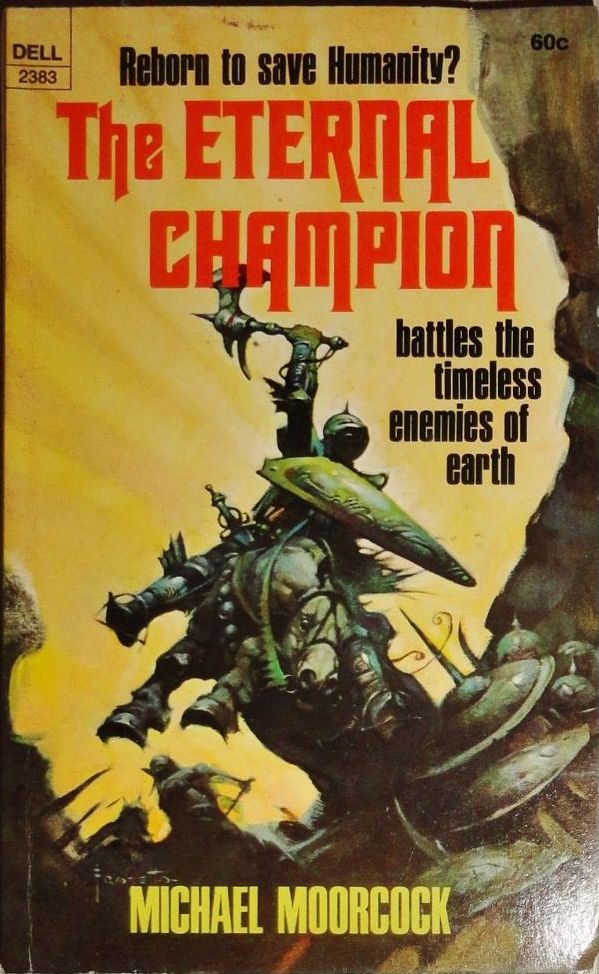
The Eternal Champion


This is a central, and yet not widely-read work in the Moorcock canon. Released in 1970, it was the work which began to explicitly tie the different heroes of his mythos together and to assemble the genuine cosmology of the titular champion. Despite this, the book itself received a muted reception, and this is in part because of the ways that its themes depart from what readers expected.

By the time he wrote this, Moorcock was already known for his hero-cycles about Elric and Dorian Hawkmoon, and here he added the central character of Erekosë – a character who, unusually, is presented with a framing device. We get the information that the hero is John Daker – a denizen of 20th century London – who has dreams in which he remembers other lives as various heroes, many of which will be recognized by fans of Moorcock’s other works. Interestingly, some of the heroes had not yet appeared in print at the time The Eternal Champion was published, establishing that Moorcock was planning his cosmology out ahead of time with considerable care.

Daker is summoned to another world by a king calling for the long-dead hero Erekosë to rise and save them from evil. While he is not sure if he is really Erekosë – a question that interestingly haunts him through the novel – he feels kinship with the king and his beautiful daughter, and agrees to take up their battle against the inhuman Eldren.

The Eternal Champion is far more thematically and philosophically complex than most other Sword & Sorcery books of the time – or any time, for that matter. It deals with questions of identity and purpose, as well as existential questions about the nature of man. Erekosë doesn’t know for certain who he is, or even if he is on Earth. He wonders if he is in the past or the future, or on some alternate world. He wonders if he is dreaming or insane, and struggles with the morality of the war he finds himself in.

Because while the reader might expect a straightforward narrative about a great hero defending humanity from insensate evil, we soon see it is not that simple. Despite the Eldren being painted as utterly evil by the other humans in the book, we begin to suspect that only blind bigotry drives their crusade, and the behavior of the humans in the war – slaughtering children and raping and murdering women – is meant to turn our stomachs just as it does the hero.

The Eldren themselves are elflike, delicate beings of strange beauty, and Erekosë feels drawn to them, especially after their princess becomes his prisoner and he finds himself questioning what he is doing. We are led along with Erekosë as he becomes disillusioned step by step, as the war progresses. When the Eldren have been driven back to their last stronghold comes the turn which makes this book so unusual, and so hard to like.

Because Erekosë turns. After first simply trying to broker peace between human and Eldren, he then joins them and helps them to fight off the human onslaught. But then the book goes further, and Erekosë decides that there can never be peace while two races exist on the same world. So he organizes a war of extermination against the human race, and wipes them all out, even hunting down survivors who hide in caves to try to escape him.

It is a really bold turn, and I can’t think of another book where the protagonist ends the story by committing genocide, much less genocide against the human race. The reader has followed Erekosë through the story, sympathizing with his doubts and fears, feeling his disillusionment and eventual disgust with the senseless violence of the humans he is in contact with. When he turns on them and helps the Eldren survive, you are totally on board with his decision.

But then the book does not stop, and really drives home the point that while we were willing to allow the genocide of an alien race – however appealing – as sad but regrettable necessity, now we have our faces rubbed in the essential ugliness of it, and the indefensible morality of the decision on either side. Even the Eldren do not agree with his actions, but he will not be stopped, as though he is driven to destroy one race or the other. This remains a fascinating, uncomfortable book, and Erekosë perhaps the most ambiguous incarnation of the Eternal Champion character.